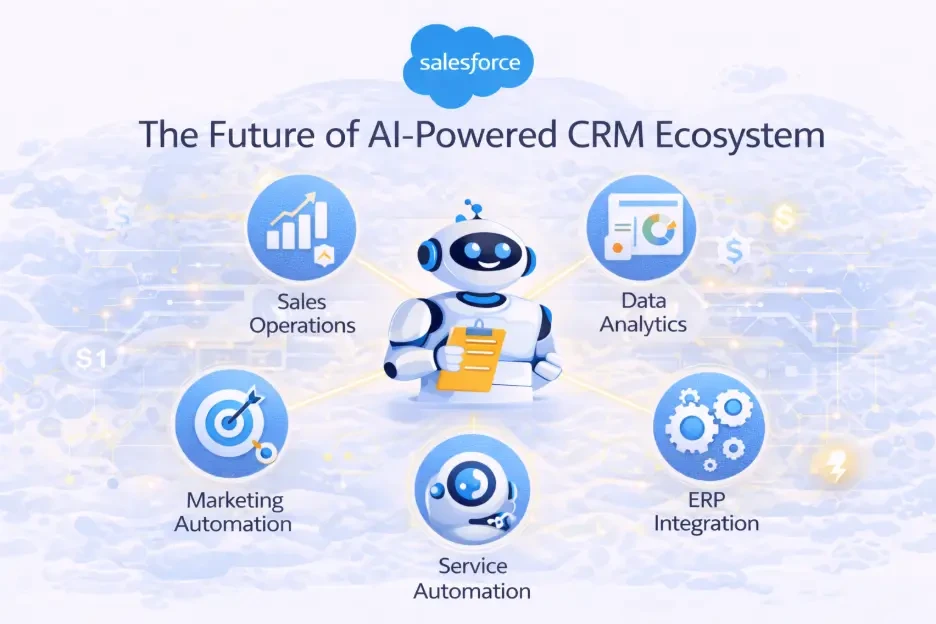
By 2026, AI-powered CRM shifts from assistive copilots that suggest text to autonomous multi-agent systems that execute complex revenue workflows across disconnected platforms. Instead of waiting for manual prompt inputs or periodic data updates, agentic CRMs proactively interpret buying signals, trigger cross-application actions, and manage customer lifecycles with minimal human intervention. Research from Creatio indicates that 86% of C-level decision-makers view AI agents as important to their strategic goals over the next two to three years. Revenue operations leaders face a clear mandate: move beyond isolated productivity boosters and re-architect the revenue engine around autonomous execution layers.
The Fundamental Shift from Reactive Copilots to Agentic CRM
In 2026, AI-powered CRM evolves from reactive copilots into autonomous multi-agent networks. While early AI tools merely summarized calls or suggested draft replies, agentic CRM systems independently identify buying signals, schedule follow-ups, update underlying database records, and coordinate cross-departmental workflows without requiring manual user intervention at every step.
The transition from passive software to autonomous agency reflects an architectural evolution across enterprise systems. Burley Kawasaki, Global VP of Product Marketing and Strategy at Creatio, articulated this transformation:
“Agentic automation is not simply another technology trend. It is the foundation of how enterprises will innovate, compete, and grow in the AI Economy.”
Market projections indicate a 35% five-year growth rate for the industry-specific AI agent sector. Market analysis from Forrester predicts a structured migration away from role-based AI modules toward collaborative multi-agent architectures. In previous CRM iterations, isolated algorithms handled single tasks such as lead scoring or email drafting. Under multi-agent architectures, specialized agents communicate through shared contextual layers, coordinating multi-step processes across marketing, sales, and service without friction.
Autonomous workflow execution fundamentally eliminates manual administrative data entry. When an account displays renewed intent through inbound interactions, an autonomous pipeline agent opens a qualified opportunity, enriches the company profile, logs previous touchpoints, and reserves calendar capacity for account executives. By delegating operational coordination to autonomous execution layers, organizations convert static databases into proactive operational engines.
Comparing Copilots, Autonomous Agents, and Multi-Agent Systems
Evaluating enterprise CRM infrastructure requires clear differentiation between assistive tools and autonomous architectures. Deploying machine intelligence without understanding operational boundaries creates redundant software investments and departmental data silos.
Operational Tier |
Primary Role |
Autonomy Scope |
Application Boundary |
Primary Risk Factor |
|---|---|---|---|---|
Assistive Copilot |
User assistance, draft composition, record summarization |
Reactive; executes solely upon direct user prompt commands |
Confined to a single interface or specific software tab |
Output hallucinations and low user adoption rates |
Autonomous Task Agent |
Single-function workflow execution (e.g., meeting scheduling) |
Semi-autonomous; initiates based on defined event triggers |
Single functional domain or dedicated system API |
Unchecked record overwriting and repetitive client outreach |
Multi-Agent Orchestration |
Cross-functional revenue management, end-to-end lifecycle execution |
Fully autonomous planning, step reversal, and sub-agent delegation |
Cross-platform enterprise stack (CRM, ERP, Billing, ITSM) |
Cascading cross-system errors and unauthorized commercial commitments |
Understanding these functional boundaries allows technology leaders to align operational responsibilities with the appropriate level of systemic oversight.
Assistive Copilots vs Autonomous Task Agents
Assistive copilots function as conversational extensions of the user interface. They depend entirely on user prompts to draft correspondence, locate records, or summarize meetings. While copilots compress task completion times for individual workers, they do not resolve the structural inefficiency of manual oversight. Human representatives must initiate every query, review the output, and physically click buttons to commit changes to the CRM database.
Autonomous task agents shift the execution model from human initiation to event-driven processing. When a customer fills out an evaluation form, a task agent immediately verifies corporate email domains, parses firmographic data from external providers, updates the lead status, and dispatches a relevant onboarding asset. Human intervention occurs only when the agent encounters an exception or an ambiguous data point outside its training parameters.
Breaking App Silos with Multi-Agent Orchestration
Embedding AI capabilities within isolated software applications creates functional silos across the organization. An intelligence tool embedded strictly in a sales platform cannot coordinate with inventory tracking systems in the ERP or entitlement tiers inside billing software. This disconnect leaves customer-facing personnel operating on fragmented, asynchronous information.
Multi-agent orchestration coordinates independent agents across functional domains. Instead of relying on static, decaying database tables, multi-agent systems maintain dynamic data models. A renewal agent observing customer churn signals can query the product usage database, alert customer success agents, coordinate with finance to verify contract terms, and draft a restructured agreement—all aligned through a unified contextual architecture.
Containing the Autonomy Blast Radius with Progressive Governance
Granting write permissions and operational autonomy to software agents introduces significant enterprise risks. Unchecked agents can misinterpret ambiguous communication, offer unauthorized discounts, corrupt master data records, or hallucinate contract terms that propagate downstream into enterprise resource planning software.
Operational Risk Warning: Deploying autonomous multi-agent systems without deterministic guardrails risks cross-system pipeline corruption. Unsupervised agents can execute incorrect commercial commitments, trigger erroneous billing events, or propagate corrupted records across the enterprise software stack.
Deterministic Guardrails and Human-in-the-Loop Triggers
Enterprise deployment frameworks presented by Rahul Sudeep emphasize Progressive Governance via Human-in-the-Loop (HITL) protocols. Rather than granting unconstrained execution authority immediately, RevOps leaders implement graduated security tiers that evaluate the sensitivity of each operational maneuver.
Low-risk actions—such as updating contact titles, transcribing calls, or generating internal research briefs—execute autonomously with automated audit logging. Medium-risk operations—such as altering pipeline stage designations or dispatching personalized emails to Tier-1 accounts—require asynchronous peer review or managerial visibility. High-risk actions—including contract revisions, custom discount commitments exceeding defined financial thresholds, or customer account mergers—trigger mandatory HITL approval gates. The agent compiles the contextual evidence, structures the decision parameters, and pauses execution until an authorized human manager reviews and signs off.
Mid-Execution Steering and Rollback Protocols
Static linear workflows fail when real-world circumstances shift during task execution. Advanced orchestration research highlights the necessity of event-driven mid-execution redirection, commonly known as steering. When new operational constraints emerge during a multi-step workflow, the system dynamically pauses, recalculates the execution path, and reverses previous dependent actions.
If an autonomous agent initiates an automated enterprise renewal workflow but detects an incoming escalation ticket regarding system outages, the orchestration engine halts the sequence. The system reverses preliminary pricing accruals, logs the incident, and recalculates the account strategy to prioritize technical resolution over commercial renewal. Modern enterprise interfaces provide transparency dashboards and override controls, equipping administrators with visual decision trees, execution logs, and instantaneous circuit-breaker controls to neutralize misaligned agent behaviors.
What Measurable Productivity Gains Can RevOps Expect by 2026?
By 2026, enterprise deployments demonstrate measurable CRM productivity gains: McKinsey benchmarks indicate potential increases of up to 50% in leads, 60% in cost reductions, and 70% cuts in call time. Furthermore, autonomous agents can independently resolve up to 80% of routine customer support issues, compressing resolution times by 60% to 90%.
The enterprise evaluation of AI CRM software has transitioned from novelty-driven experimentation to stringent financial accountability. Technology officers evaluate solutions against verifiable labor savings, conversion acceleration, and system-wide overhead reductions.
Hard ROI Benchmarks: Bouygues Telecom and Industry Metrics
Telecommunications provider Bouygues Telecom deployed generative AI models to modernize call center operations. Implementing automated call summarization and real-time agent guidance achieved a 30% reduction in call handle times, ultimately generating $5 million in operational cost savings. Customer service representatives avoided manual documentation, reallocating capacity toward complex technical problem-solving.
Wider cross-industry evaluations reflect comparable gains. Companies deploying AI CRM solutions report an average 29% increase in sales along with 34% improvements in customer service efficiency. Predictive customer retention accuracy reaches up to 90% in environments where algorithms continuously analyze usage telemetry, payment trends, and support sentiment.
Expanding to Multimodal Voice and Video Intelligence
CRM analytical capabilities have expanded beyond basic text processing into multimodal signal interpretation. Multimodal revenue intelligence engines analyze real-time video engagement, tracking physical cues, vocal inflections, and attention indicators during commercial presentations. Acoustic voice analytics identify rising agitation, hesitation, or disengagement that standard text transcriptions overlook.
In structured operational environments—such as underwriting pipelines and technical support hubs—multi-agent networks manage complex documentation workflows. Document AI agents extract and validate structured information from balance sheets and application forms, while Decision AI agents evaluate corporate policy compliance. Deploying specialized agent pairs enables organizations to resolve up to 80% of routine processing tickets without manual intervention, compressing review cycles that previously took days into minutes.
Overcoming CRM Adoption Drift and Automation Fatigue
Despite advanced computational capabilities, enterprise software investments remain vulnerable to human abandonment. When automated systems introduce operational friction or produce irrelevant outreach, sales teams abandon the corporate platform in favor of private spreadsheets and unmonitored communication channels. Peter Martin identified this operational failure mode:
“CRM adoption rarely dies at once. It drifts, as the system gets slower, less trusted, or less useful than the workarounds people build around it.”
Sustaining CRM integrity requires systematic operational governance to prevent system drift and restore end-user confidence.
- Review Adoption Signals: Track system log metrics against the previous operational period, identifying declining field completion rates and sudden drops in interface activity.
- Sample Problem Records: Manually inspect a sample of recent accounts to identify incomplete fields, duplicate entries, or misapplied agentic tags.
- Identify Workflow Causes: Determine whether pipeline bottlenecks stem from rigid required fields, misfiring automated validation rules, or restrictive permission sets.
- Assign Corrective Actions: Establish specific operational remediation tasks, designating single functional owners and strict thirty-day deadlines.
- Re-Check Operational Results: Measure adoption indicators and data hygiene scores the following month to verify that process adjustments eliminated user friction.
Balancing automation with human nuance requires designing customer interactions through the lens of emotional efficiency. McKinsey reports that 65% of consumers will abandon online transactions due to inflexible return policies. Agentic systems can automate the entire returns lifecycle—authorizing claims, generating shipping labels, and coordinating inventory exchanges instantly. However, deploying rigid automated responses without empathetic escalation paths degrades brand perception. Revenue teams must configure systems to identify customer frustration early, immediately transferring emotionally sensitive scenarios to experienced human specialists.
Data Readiness, Security, and Compliance Prerequisites
McKinsey research demonstrates that 90% of companies now use AI tools in at least one business function, while 81% of sales professionals were already using AI in daily operations by 2023. Transforming these baseline tools into autonomous enterprise agents requires extensive underlying data preparation and strict regulatory compliance controls.
Chaviva Gordon-Bennett and Anna Zur highlight that AI CRM deployments process sensitive personal and financial information, creating strict corporate compliance duties. Organizations must involve corporate legal and regulatory officers during initial planning stages to implement data minimization, establish verifiable consent tracking, define data retention schedules, and comply with international cross-border data transfer regulations.
System usability relies on clear interface collaboration indicators. Platforms like monday CRM incorporate dynamic content generation environments where users define tone, set content length, and preview generated output before executing communications. Enterprise interfaces must provide explicit visual distinctions that clearly separate records created by human representatives from entries committed by autonomous agents. This visual separation preserves operational accountability and simplifies retrospective auditing.
Securing the enterprise boundary requires strict defenses against indirect prompt injection. External adversaries can manipulate autonomous SDR or support agents by embedding malicious instructions within inbound contact forms, resumes, or support tickets. IT security teams must isolate unverified customer inputs from internal reasoning engines, applying strict data sanitization and zero-trust permissions before permitting agents to trigger operational workflows.
FAQ
How does agentic CRM change software licensing and seat-based pricing?
As multi-agent systems complete workflows previously managed by human personnel, enterprise software vendors are transitioning away from standard monthly per-seat licenses. Organizations are increasingly adopting outcome-based billing, compute consumption credits, and pay-per-resolution pricing structures that scale directly with successful agent task execution.
What is the difference between an AI copilot and an AI agent in CRM?
A copilot operates strictly as an assistive interface that generates drafts, summarizes interactions, or retrieves documents when manually prompted by a human user. An AI agent operates semi-autonomously or fully autonomously, monitoring event streams, planning multi-step actions, and executing cross-application tasks without requiring manual prompts.
How do multi-agent CRMs coordinate across different enterprise software platforms?
Multi-agent architectures coordinate through shared contextual protocols, API execution engines, and centralized data layers rather than remaining inside single applications. This connectivity allows an agent operating within the CRM to coordinate with ERP financial ledgers, ITSM ticketing platforms, and external communication channels.
How can companies defend autonomous CRM agents against indirect prompt injection?
Enterprises protect autonomous CRM agents by decoupling raw inbound customer inputs—such as web forms, emails, and attachments—from core decision models. Revenue teams implement input sanitization, enforce strict role-based access controls, and apply mandatory Human-in-the-Loop review gates before agents execute commercial commitments.