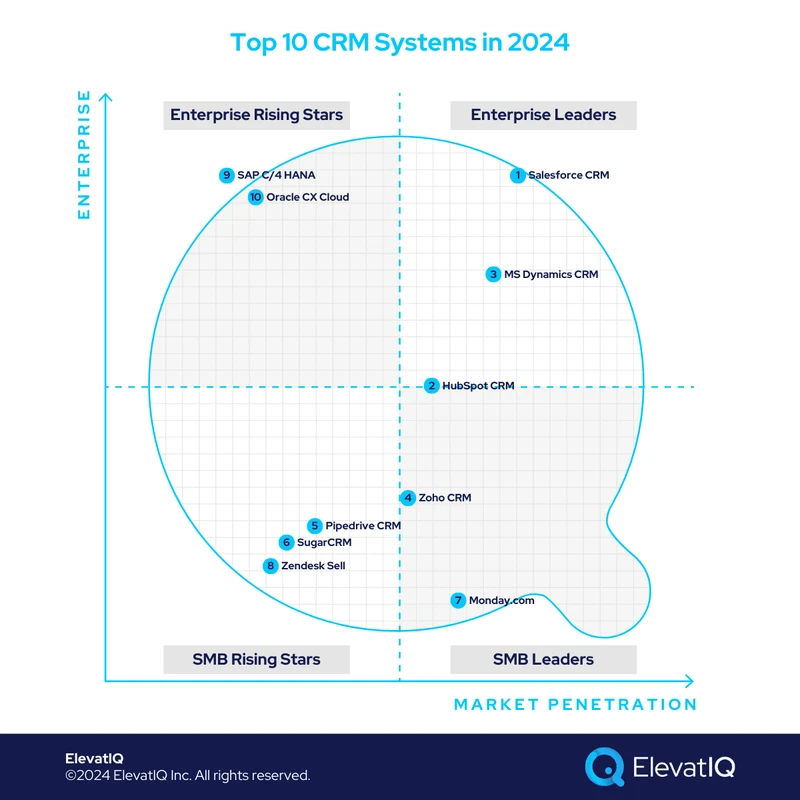
No single enterprise cloud CRM suits every corporate architecture: Salesforce dominates organizations prioritizing an expansive independent application ecosystem and autonomous AI, Microsoft Dynamics 365 is the optimal choice for enterprises requiring unified CRM and ERP operations on Microsoft Dataverse, Oracle CX Cloud excels for organizations tied to Oracle financial back-offices, and Creatio serves enterprises needing no-code adaptability with hybrid cloud and on-premise flexibility.
Holding more than 24% of the global customer experience market share, Salesforce remains the cornerstone of enterprise cloud CRM deployments for complex global organizations. However, enterprise architects and RevOps leaders managing 500+ seat deployments face structural trade-offs that transcend brand ubiquity. Industry research outlines that enterprise platforms combine operational, analytical, collaborative, and strategic CRM functions into comprehensive suites. At large scale, long-term operational success depends on how cleanly a platform’s database model aligns with existing business workflows, ERP backbones, and governance boundaries.
Platform Selection Verdict by IT Architecture and Scale
Selecting an enterprise cloud CRM depends on your core IT architecture: Salesforce leads for expansive independent software ecosystems and autonomous AI workflows via Agentforce, Microsoft Dynamics 365 wins for native ERP unification on Microsoft Dataverse, and Oracle CX Cloud suits organizations requiring direct financial risk modelling in Oracle ERP.
Enterprise technology leaders often discover that sales automation and service routing features have achieved broad parity across top-tier vendors. Industry analysis from Belt Creative emphasizes this reality:
“The choice between Microsoft Dynamics 365 and Salesforce is not really about which has more features. At enterprise scale, both platforms can do almost anything you need.”
Because functional capabilities overlap across core tiers, the platform selection verdict hinges directly on architectural alignment. Organizations must choose between two distinct technological philosophies: pure-play customer engagement platforms that connect outwards to disparate business systems, or unified operational ecosystems where front-office revenue generation and back-office resource planning share a common data substrate.
Salesforce functions as an independent customer engagement cloud, sitting at the center of an organization while orchestrating point solutions through deep application programming interfaces. Microsoft Dynamics 365 and Oracle CX Cloud take the opposite approach, embedding pipeline management directly inside larger enterprise operational suites. Creatio occupies an alternative niche, offering composable no-code agility for mid-market and enterprise organizations that require rapid interface modifications without technical debt. Selecting the wrong paradigm produces severe integration drag, elevated maintenance costs, and brittle synchronization pipelines across corporate systems.
Platform Architecture and Back-Office ERP Alignment
Underlying data architectures dictate how efficiently customer touchpoints inform operational decisions across the broader enterprise stack.
Microsoft Dataverse and Front-to-Back Office ERP Unification
Microsoft Dynamics 365 eliminates data synchronization delays by running sales, customer service, field operations, and ERP modules directly on Microsoft Dataverse. Rather than relying on scheduled batch imports or complex webhook architectures to reconcile customer accounts with operational databases, Dynamics 365 natively writes to a shared data structure. When an enterprise account executive closes an opportunity, the transaction immediately registers within supply chain engines, inventory management modules, and billing ledgers without requiring intermediate middleware. This architecture substantially lowers integration maintenance overhead for companies already anchored in Microsoft enterprise infrastructure.
The Salesforce AppExchange and Agentforce Autonomous AI Layer
Salesforce maintains independence from back-office operational suites by cultivating a vast marketplace ecosystem. With between 7,000+ and 8,000+ applications available on the Salesforce AppExchange, enterprises can connect specialized third-party tools across contract lifecycle management, digital document generation, and marketing automation. Salesforce reinforced this application-centric model by introducing the Agentforce autonomous AI agent framework in 2024. Agentforce deploys automated agents across customer-facing workflows to execute multi-step tasks without human intervention. The platform relies on sophisticated APIs to exchange records with third-party ERP databases, requiring dedicated engineering oversight to keep high-volume data pipelines stable.
Oracle CX Cloud and Intelligent Financial Data Integration
Oracle CX Cloud provides specialized integration points for organizations managing their core accounting within Oracle Cloud ERP. Rather than treating customer relationship management as an isolated pipeline tracker, Oracle links front-office interaction streams directly with financial records. This bidirectional connection calculates actual customer lifetime value and real-time financial risk indicators directly on customer records. Oracle CX Cloud incorporates Oracle Intelligent Advisor, an advanced business rules engine formerly known as Oracle Policy Automation, enabling complex regulatory calculations and pricing rules during live customer interactions. Gartner has also evaluated Oracle’s service suite as providing one of the industry’s most functional and scalable knowledge management systems.
- Microsoft Dataverse: Consolidates CRM records, Power Platform assets, and ERP operational tables into a single database schema, eliminating point-to-point data synchronization pipelines.
- Salesforce AppExchange: Provides access to over 7,000 pre-built enterprise tools, relying on external API connectors to interface with external back-office accounting engines.
- Oracle Intelligent Advisor: Enforces complex corporate compliance policies and financial risk rules across both front-office service engagements and back-office ERP ledgers.
Head-to-Head Comparison Across Core Enterprise Criteria
Evaluating enterprise platforms requires analyzing underlying data structures, commercial entry thresholds, and environmental flexibility rather than marketing feature lists.
Enterprise Platform |
Underlying Architecture |
Starting Enterprise Price |
User Constraints |
Deployment Flexibility |
|---|---|---|---|---|
Salesforce |
Multi-tenant Cloud, AppExchange ecosystem |
$175/user/month (Enterprise) |
None (Target: 500+ seat enterprises) |
Pure Cloud (Multi-region SaaS) |
Microsoft Dynamics 365 |
Microsoft Dataverse unified data layer |
$105/user/month (Enterprise) |
15-user minimum on core tiers |
Microsoft Azure Cloud Ecosystem |
Oracle CX Cloud |
Oracle Cloud Infrastructure & ERP Linkage |
Custom Enterprise Licensing |
Strict contract matrix guidelines |
Oracle Cloud Infrastructure |
Creatio |
Composable No-Code, AI-native platform |
Modular per-app pricing |
Unlimited users supported |
Cloud, Hybrid, and On-Premise |
The comparative matrix highlights critical operational boundaries that enterprise IT departments must navigate during procurement. While Salesforce captures 24% of the global market and Gartner regularly evaluates 16 leading vendors in its Customer Engagement Center analysis, architectural trade-offs emerge when reviewing seat thresholds and deployment models. Microsoft Dynamics 365 enforces a strict 15-user minimum on its core tiers, creating operational friction when IT departments attempt phased pilot rollouts across isolated business units.
Creatio distinguishes itself in architectural flexibility by earning a 4.7 / 5 rating on G2 while supporting both cloud and on-premise infrastructure. Organizations operating under strict data residency mandates or distributed enterprise topologies can deploy Creatio locally or within private clouds while maintaining no-code process modeling across unlimited user bases.
Licensing Realities and Total Cost of Ownership Escalation
Enterprise cloud CRM licensing escalates rapidly beyond base subscription fees. Salesforce pricing scales from $25 per user monthly up to $550 for Agentforce 1, with a 4x increase from Starter to Pro. Dynamics 365 ranges from $65 to $150 but enforces a 15-user minimum, while implementation consultants inflate overall ownership costs.
Commercial schedules published across cloud vendors reveal steep pricing gradients as organizations scale functional capabilities. Salesforce starts at $25 per user monthly for its basic Starter Suite, billed annually. Stepping up to the Pro Suite introduces an immediate 4x price jump to $100 per user monthly. True enterprise deployments require the Enterprise tier at $175 per user monthly or the Unlimited tier at $350 per user monthly. Deploying advanced autonomous intelligence workflows drives seat licensing to $550 per user monthly for the Agentforce 1 Sales edition.
Microsoft Dynamics 365 structures its modular commercial tiers around predictable operational roles: the Professional tier costs $65 per user monthly, the Enterprise tier costs $105 per user monthly, and the Premium tier reaches $150 per user monthly. However, the mandatory 15-user minimum creates a non-negotiable budget floor that complicates small-scale departmental testing.
Total Cost of Ownership Multipliers: Software subscription fees rarely represent more than half of the true five-year cost of ownership. Industry analysis from Insightly warns that implementations typically require dedicated internal administrators, while complex workflows demand certified systems integrators, pushing total expenditure far beyond baseline seat licenses. For organizations with 500+ employees, standard enterprise implementations demand an 8 to 16-week deployment runway accompanied by recurring consulting retainers.
Secondary operational costs rapidly compound base subscription commitments. Technical teams must account for specialized administrative headcount, sandbox tenant fees, external storage consumption, and third-party AppExchange subscription add-ons. Overlooking these dependent systems results in immediate budget overruns during enterprise rollouts.
Deployment Safeguards to Prevent Performance and Compliance Failure
Migrating enterprise CRM platforms introduces substantial operational risks, ranging from analytical database locks to regulatory non-compliance.
Migration Failure Risks: Unoptimized migration scripts, improperly sized target database schemas, and unindexed relationship tables cause severe dashboard freezes and pipeline latency during critical enterprise sales cycles. Unplanned downtime or data corruption during cutover can stall revenue-generating divisions for days.
Technical Migration Protocols and Query Observability
To eliminate post-cutover instability, enterprise architects must institute a rigorous, multi-phase technical deployment framework:
- Pre-Migration Asset Assessment: Complete a comprehensive data inventory mapping custom objects, relationship dependencies, schema complexity, and reporting pipelines with database administrators and business leads.
- Data Migration Rehearsals: Execute full end-to-end data migration dry runs within isolated staging environments using representative production data. Rehearsals expose schema mismatches, API rate limits, and processing bottlenecks before touching production environments.
- Rollback Protocol Verification: Capture complete source system snapshots and test transactional rollback procedures to restore original services without data loss if cutover thresholds are breached.
- Continuous Data Observability: Implement real-time data health monitoring to track query latency, schema drift, API timeouts, and record duplication post-launch.
Standard reporting capabilities often trigger technical bottlenecks. Industry documentation notes that built-in CRM reporting tools frequently fall short of enterprise analytical standards, forcing technical teams to implement external business intelligence pipelines to prevent transaction engine slowdowns caused by heavy analytical queries.
Compliance Boundaries and Procurement Matrix Navigation
Regulatory boundaries dictate architectural feasibility in heavily governed sectors. For instance, evaluation reports note that certain platforms lack regional data hosting commitments, creating compliance barriers for organizations bound by strict sovereign data regulations. IT leaders must verify that their target cloud CRM maintains verified data centers within their operational jurisdictions before initiating procurement.
Procurement navigation presents another major procedural friction point. Gartner client inquiry data documents that enterprise buyers frequently struggle with Oracle’s complex licensing structure and contract matrix. Stringent approval procedures and lengthy contractual workflows require procurement teams to build extensive legal review buffers into overall deployment timelines.
Strategic Recommendation: Matching Platforms to Business Architecture
Enterprise cloud CRM selection must follow existing technical architecture rather than broad feature checklists. Because leading platforms match each other across core sales and service functionalities, the deciding factor is how seamlessly the tool integrates with existing data assets.
Enterprise organizations should align their platform selection against these explicit architectural boundaries:
- Select Salesforce: If your organization requires access to the deepest third-party application ecosystem (over 7,000 AppExchange solutions), relies on autonomous AI orchestration via Agentforce, and maintains a dedicated in-house administration team capable of governing custom Apex schemas.
- Select Microsoft Dynamics 365: If your operational backbone is built on Microsoft Azure and Microsoft 365, and your priority is uniting customer pipeline data directly with ERP financial engines on Microsoft Dataverse without paying for external middleware connectors.
- Select Oracle CX Cloud: If your core accounting and supply chain operations run natively on Oracle Cloud ERP, and your revenue operations team requires live customer lifetime value and risk modeling powered by Oracle Intelligent Advisor.
- Select Creatio: If your enterprise values no-code agility, supports distributed teams requiring rapid process reconfiguration, and operates under regulatory mandates that necessitate hybrid or on-premise infrastructure deployment options.
Before executing multi-year contracts for 500+ user licenses, technical leadership should mandate running a live sales cycle pilot. Routing an actual enterprise deal through a fully configured trial instance reveals workflow bottlenecks, usability friction, and integration challenges that standard vendor demonstrations inevitably conceal.
FAQ
Why does Microsoft Dynamics 365 enforce a 15-user minimum on core tiers?
Microsoft Dynamics 365 enforces a 15-user minimum on its core tiers to target committed enterprise deployments rather than casual single-seat users. This policy establishes a non-negotiable budget baseline, requiring procurement teams to plan departmental rollouts carefully to avoid paying for unused licenses during early adoption phases.
What causes cloud CRM reporting dashboards to freeze during live enterprise sales cycles?
Reporting dashboards freeze when unoptimized database schemas, unindexed custom tables, and heavy real-time analytical queries overload the CRM transaction engine. Without dedicated data warehousing or external business intelligence tools, complex queries execute against operational database tables, creating severe latency bottlenecks during high-volume sales periods.
How significantly do implementation services increase enterprise cloud CRM costs beyond licensing?
Implementation services, custom integrations, and specialized consultants frequently double or triple software seat expenses over a five-year lifecycle. Complex enterprise configurations require certified partner assistance across 8 to 16-week deployment cycles, alongside ongoing salaries for dedicated full-time administrators to maintain custom schemas.
What is Salesforce’s share of the global customer experience market?
Salesforce holds more than 24% of the global customer experience market share. This significant market presence provides an expansive third-party software ecosystem on AppExchange, a vast pool of certified developers, and consistent platform updates across international enterprise deployments.