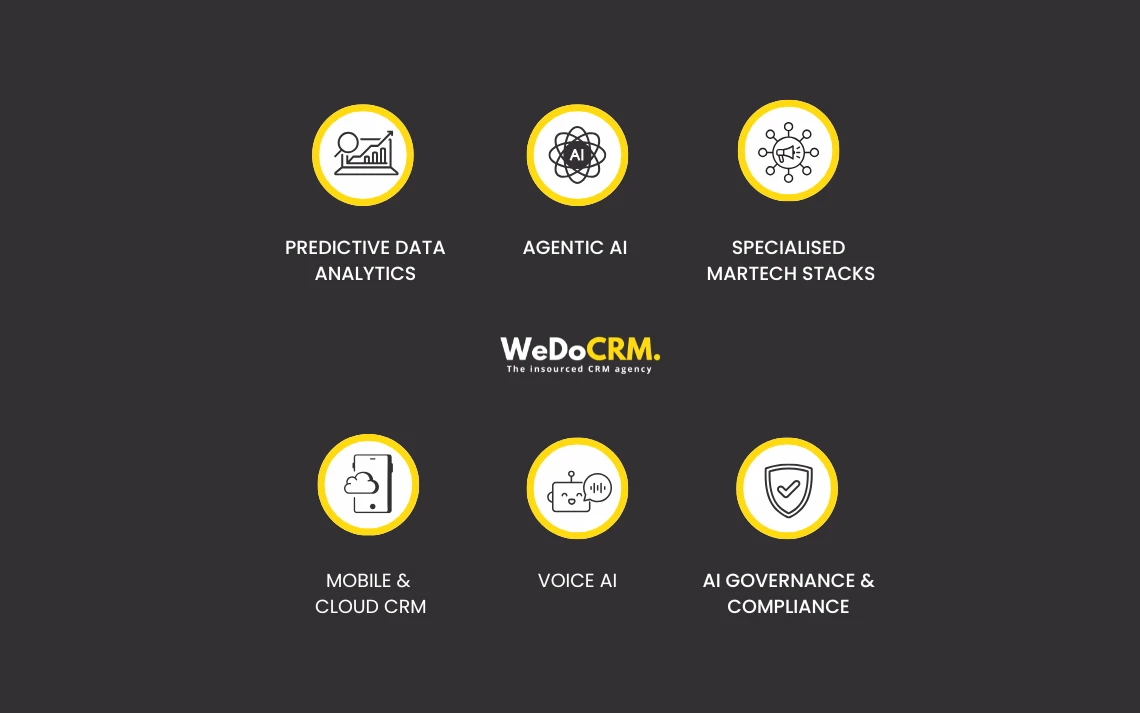
CRM in 2026 is shifting from passive systems of record to autonomous systems of action. Rather than simply logging interaction histories or suggesting draft text, platforms now orchestrate specialized AI agents that independently analyze intent, update multi-system records, and execute cross-departmental operations without manual intervention. Forrester analyst Kate Leggett observed that “CRM in 2026 is undergoing a structural shift, not just an incremental evolution,” marked by Gartner’s projection that 40% of enterprise applications will embed task-specific AI agents by late 2026.
The Autonomous Shift: How Agentic Systems Replace Assistive Copilots
In 2026, CRM platforms are transitioning from assistive generative AI copilots to autonomous agentic workflows. While copilots merely draft content and suggest next steps, autonomous agents execute end-to-end tasks across sales, marketing, and support—orchestrating multi-system updates, validating client records, and resolving workflows independently under predefined organizational boundaries.
This operational transition marks a decisive departure from the early trials of generative software. As Neal Weinberg reported for CIO, “Agentic AI has advanced from the promises-and-pilots phase of 2025 to reality and rollouts in 2026.” Forrester data indicates that 70% of companies already deploy AI within their customer management ecosystems, but the underlying mechanisms have fundamentally transformed. While 2025 focused on human-prompted chatbots producing call summaries or email variations, 2026 architectures assign multi-step execution responsibilities to coordinated background agents.
Adoption metrics confirm that agent fleets are expanding rapidly across production environments. Enterprise organizations run an average of 12 distinct AI agents across customer-facing workflows, with enterprise projections showing that figure climbing 67% within two years. Market momentum highlights this appetite: Salesforce reported surpassing 29,000+ Agentforce deals following its launch, reflecting rapid enterprise commitment to autonomous architecture. Instead of waiting for a sales representative to manually convert a lead, assign an account tier, and schedule onboarding milestones, enterprise platforms deploy specialized agents to parse prospect intent, query internal entitlement databases, trigger enterprise resource planning (ERP) provisioning calls, and confirm appointments synchronously.
The strategic priority for software architects is orchestrating these agents across enterprise boundaries. Modern platforms no longer treat customer management software as an isolated directory. As business software provider Frigat NET observed, modern platforms function as technological systems that process operational data faster, build relationships more precisely, and allocate enterprise resources rationally. Orchestrating agentic execution means individual agents must negotiate dependencies, such as verifying inventory thresholds in supply chain modules before committing delivery windows during an automated contract negotiation.
Collaborative Workspaces and Conversational Interfaces in Live Sales
Enterprise customer engagements are shedding traditional email chains and disjointed record updates in favor of unified digital rooms. Gartner forecasts that by late 2026, 80% of enterprise sales cycles will incorporate at least one shared digital workspace. These persistent collaborative environments link buyers, account executives, technical solution architects, and automated support agents within a shared console that streams deal terms, security questionnaires, and mutual action plans directly into core customer records.
At the same time, manual form-based data entry is giving way to dynamic conversational interfaces and spatial data inputs. Sales operations teams increasingly rely on natural language processing to log account notes, calculate forecast probabilities, and update pipeline status via ambient voice capture. Frontline mobile functionality has become a primary driver of pipeline attainment, with data demonstrating that sales teams using mobile CRM interfaces are 150% more likely to hit their assigned quotas compared to desk-bound peers.
- Shared Buyer-Seller Workspaces: Rather than passing static PDF proposals across disparate email threads, teams negotiate commercial contracts within interactive digital rooms where document edits trigger instant revision histories and compliance checks against enterprise legal guidelines.
- Ambient Voice and Conversational Entry: Field representatives capture unstructured verbal updates following buyer interactions, while natural language agents extract deal milestones, competitors mentioned, and expected close dates to populate pipeline fields automatically.
- Spatial and Multimodal Telemetry: Enterprise software vendor SAP documents that multimodal augmented reality (AR) and virtual reality (VR) inputs now communicate telemetry directly to core customer records. When an enterprise field engineer or buyer interacts with 3D product configurations or troubleshoots equipment within virtual spaces, the contextual diagnostic data automatically instructs downstream service queues without manual input.
- Real-Time Deal Signals: Automated systems monitor buyer participation metrics within digital workspaces, flagging deal stagnation risks and alerting sales leadership before pipeline slippage disrupts quarterly projections.
The Pricing Overhaul: The Sunset of Pure Per-Seat Subscriptions
Enterprise procurement teams are confronting a fundamental disruption in software economics as pure per-seat subscription models recede. For more than two decades, software licensing scaled proportionally with human headcount. However, because autonomous agents perform operational tasks previously requiring human workers, vendors are restructuring contracts around consumption units, computational credits, and verified business outcomes.
The scale of the broader market underscores this commercial evolution. Research from B2B prospecting platform Sopro estimates the annual revenue of the CRM software market at £80.60 billion (about $107.8 billion) in 2026, expanding at a compound annual growth rate (CAGR) of 14.6% toward £117.16 billion (about $156.7 billion) by 2030. Average enterprise expenditure per employee reaches £21.45 (about $29) in 2026. Because software agents now handle high-volume routine inquiries, account updates, and quote generation, charging strictly by human user seats fails to capture platform utilization, prompting vendors to introduce hybrid contracts that blend baseline seat fees with metered agent compute costs.
This monetization shift introduces substantial financial unpredictability for enterprise technology leaders. CIOs and sales operations directors must institute dedicated CRM FinOps disciplines to monitor, audit, and cap fluctuating usage expenses. Unchecked autonomous loops can generate runaway token consumption, where an agent repeatedly queries external databases or executes recursive reasoning chains during complex billing disputes. Without hard architectural spend ceilings and programmatic rate-limiting rules embedded into enterprise API gateways, organizations face unpredictable billing overages that outpace legacy seat-based budgets.
The 2026 Data Paradox: Dirty Databases vs. Autonomous Agents
Autonomous agents introduce severe operational hazards when deployed across neglected data foundations. A pronounced operational contradiction defines enterprise customer systems: industry surveys show that most organizations identify CRM data as the operational cornerstone of their business, yet many admit that less than half of their customer data is accurate and complete. While human sales representatives can intuitively navigate outdated job titles, duplicate accounts, and missing postal codes, autonomous agents interpret corrupted records literally.
Autonomous software agents execute business actions at speeds that amplify data flaws exponentially. When an agent processes records containing conflicting enterprise hierarchy data or stale contract terms, it immediately triggers unauthorized discounting, schedules fulfillment against defunct shipping addresses, or issues contradictory legal addenda. As RapidiOnline points out: “New tools do not fix broken data or unclear processes.”
Resolving this vulnerability requires moving away from periodic, manual database deduplication toward continuous background data hygiene. Automated synchronization pipelines must cleanse, normalize, and verify data points before agent architectures access system entities. Data engineering teams deploy synthetic customer data environments to stress-test agent logic, ensuring automated workflows resolve conflict scenarios safely without exposing sensitive, regulated personally identifiable information (PII) to unvetted large language model context windows.
Regulatory scrutiny intensifies this technical requirement. Compliance frameworks enforce rigorous documentation standards on automated profiling, biometric sentiment tracking, and algorithm-driven deal scoring. Operating an autonomous agent that calculates credit terms or dynamic enterprise pricing based on unverified, hallucinated customer profiles creates direct legal and regulatory exposure. Enterprise systems must maintain verifiable audit trails showing the exact data inputs and deterministic rules that guided any agent-executed customer transaction.
Agent Autonomy Governance Matrix: Deploying Controlled Workflows
Deploying autonomous agents without rigid governance boundaries invites systemic operational failure. As automation vendor Straive illustrates, an advanced autonomous agent can read an incoming email complaint, query account histories in the CRM, evaluate real-time warehouse inventories, dispatch a replacement shipment, notify the client, and close the corresponding service ticket. However, granting unconstrained autonomy across all customer operations introduces unacceptable corporate risk.
Technical architecture must anchor every automated workflow to strict programmatic boundaries. Salesforce research reveals that 94% of enterprise IT leaders believe agent success depends entirely on an API-led architecture. Rather than permitting generative agents to produce arbitrary outputs or execute unvalidated system modifications, organizations must enforce a three-tier governance matrix that dictates when an agent may act independently, when it requires human authorization, and when automated execution is strictly prohibited.
Autonomy Tier |
Qualifying CRM Workflows |
Data & API Requirements |
Human Supervisory Control |
Failure & Rollback Protocol |
|---|---|---|---|---|
Tier 1: Autonomous Execution |
Standard ticket triage, contact data hygiene, meeting scheduling, low-risk catalog order dispatch. |
Read/write access to staging tables; rate-limited webhooks; strict field validation schemas. |
Zero human intervention during runtime; weekly programmatic log audits and anomaly alerts. |
Instant programmatic rollback via state snapshots; transaction reversion if idempotency check fails. |
Tier 2: Supervised Execution |
Mid-market contract generation, standard discounting up to 15%, customer refund approvals up to $1,000. |
Bidirectional API access to ERP and billing modules; verified PII masking tokens. |
Mandatory human sign-off; visual diff presented in rep console before system commit. |
Automated queue freeze; notification routed to sales operations manager; manual draft override. |
Tier 3: Human-Only Action |
Custom Master Services Agreements (MSAs), major dispute settlements, executive discounting, regulatory disclosures. |
Read-only contextual lookups; blocked API endpoints for transactional update calls. |
Complete human ownership; agent restricted strictly to information retrieval and synthetic modeling. |
System hard-stop; automated termination of agent process if external writing attempt is detected. |
This operational framework prevents rogue agents from making unauthorized financial or contractual commitments while preserving process velocity for routine enterprise tasks. Integrating API-led gateways ensures that every automated call passes through authentication layers, schema verifications, and compliance checks before modifying core enterprise databases.
Connected Enterprise Architecture: Unifying CRM and Revenue Engines
Integrating CRM directly with external operations and prospecting stacks drives 35% annual recurring revenue growth, compared to only 19% for standalone CRM. By 2026, 87% of deployments are cloud-based, relying on bidirectional API connectors and low-code builders to synchronize customer signals across ERP, billing, and fulfillment in real time.
The performance differential between unified and isolated architectures directly impacts pipeline velocity. Sopro research demonstrates that pairing customer records directly with automated lead generation systems elevates deal conversion rates from 34% up to 52%. Standalone databases force account executives to cross-reference multiple point solutions, introducing delays that disrupt sales engagement. In contrast, cloud platforms utilizing Integration Platform as a Service (iPaaS) middleware ingest prospecting signals directly into live opportunity pipelines, allowing automated qualification routines to execute instantly.
Architectural decoupling is accelerating across large enterprises replacing rigid monolithic legacy platforms. Organizations are breaking down sprawling Apex and Visualforce codebases into composable, headless architectures connected through microservices and lightweight event buses. This approach allows enterprise teams to build customized, drag-and-drop user interfaces for frontline representatives while routing operational tasks through low-code workflow builders. Furthermore, field sales operations depend on sophisticated offline-first architectures: mobile applications run local edge caches with deterministic conflict-resolution protocols, ensuring that offline updates entered by traveling sales reps reconcile cleanly with simultaneous cloud-level agent updates without corrupting pipeline history.
Security engineering must keep pace with these sprawling integration networks. Exposing customer data across extensive API ecosystems creates threat vectors such as prompt injection via incoming customer emails and unauthorized privilege escalation. Enterprise architects must enforce zero-trust policies across every API endpoint, ensuring all external connectors adhere to least-privilege permissions, cryptographic payload verification, and strict accessibility standards to support accessible, dynamic conversational interfaces across the organization.
FAQ
What is the primary difference between a CRM copilot and an agentic CRM in 2026?
Copilots assist human workers by summarizing calls and drafting text, whereas agentic CRMs autonomously execute workflows across multiple business systems—such as verifying stock, issuing replacement orders, and updating records—without human intervention.
How are CRM pricing and software licensing models changing in 2026?
Enterprise vendors are moving away from traditional per-seat licensing toward usage-based, agent-based, and outcome-driven pricing structures, reflecting work performed by software agents rather than human login counts.
Why does poor data quality pose a severe risk to agentic CRM deployments?
While most leaders consider CRM data critical, many report that less than half is accurate. Autonomous agents operating on conflicting or outdated data execute erroneous orders, issue incorrect pricing, and misroute customer accounts.
What architectural capability is most essential for 2026 CRM success?
Salesforce research indicates 94% of IT leaders view an API-led architecture as mandatory. Robust bidirectional APIs prevent disconnected point-solution overlays and allow multi-agent systems to orchestrate actions securely across ERP and CRM.
Conversions use a rate of 1 GBP = $1.34 as of November 9, 2026; rates may change.