For US small businesses on a strict budget, Bigin by Zoho CRM is the top overall pick, providing essential pipeline tracking and custom dashboards for up to $21 per user monthly. Teams requiring free live support should choose Freshsales for its 24/5 phone and chat assistance, while visual project-driven teams benefit most from Monday CRM’s automated board layouts.
Selecting software for customer relationship management often forces founders and sales managers into a difficult trade-off between overly rigid entry-level apps and costly enterprise suites. According to software testing published by PCMag, Bigin earned Editors’ Choice recognition with a 4.0 out of 5.0 score, matching the 4.0 rating achieved by Freshsales. Forbes Advisor similarly awarded Bigin a 4.6-star rating, designating it the premier budget option for lean operations. Navigating the market requires examining hard technical limits—such as user seat caps, contact database ceilings, and communication channels—before committing operational workflows to a specific platform.
Quick Verdict: Best Small Business CRMs by Operational Focus
The best CRM for small businesses depends on operational priorities: Bigin by Zoho CRM leads for affordability at under $21 per month; Freshsales offers the best free plan with 24/5 live support; Monday CRM provides the best customizable visual dashboards; and Salesmate excels for outreach with unlimited contacts.
Independent testing benchmarks from Forbes Advisor and PCMag highlight stark differences in how entry-level platforms serve specific sales motions. While generic CRMs treat all customer records identically, specialized architectures reward distinct operational structures:
- Bigin by Zoho CRM (Forbes Advisor Rating: 4.6/5.0 stars | PCMag Score: 4.0/5.0): Best for micro-teams seeking cost ceilings under $21 per user per month with clean pipeline views.
- Freshsales (PCMag Score: 4.0/5.0 | Free Tier: 3 Seats): Best for budget-constrained teams that cannot afford downtime and require live phone, chat, and email support without paying a monthly fee.
- Monday CRM / Monday.com (Forbes Advisor Rating: 4.3/5.0 stars): Best for visual project teams needing automated deal progression connected directly to daily operational boards.
- Salesmate (Forbes Advisor Rating: 4.4/5.0 stars): Best for outbound prospecting teams that manage high-volume lead databases and require unified calling, texting, and emailing.
- Zoho CRM (Forbes Advisor Rating: 4.8/5.0 stars): Best for teams ready for advanced stage-based Kanban task management and deeper customization beyond entry-level pipeline tools.
- Agile CRM (Forbes Advisor Rating: 4.5/5.0 stars): Best for bootstrapped startups needing the highest raw seat count on a zero-dollar tier, supporting up to 10 users.
Evaluators at PCMag also scored Pipedrive CRM at 3.5 out of 5.0 rating points, reinforcing that higher price tags do not always translate to superior usability for small teams. Choosing the correct platform demands matching your daily sales cadence against verified software constraints.
Bigin by Zoho CRM: Top Budget-Friendly Pipeline Management
Bigin by Zoho CRM addresses a persistent challenge for American small business owners: accessing modern pipeline tracking tools without paying enterprise software subscriptions. Forbes Advisor researchers highlighted Bigin’s balance of cost and functionality, stating:
“Our research found that Bigin is the best small business CRM for teams on a budget, earning a 4.6 star rating from our research team.”
This assessment matches testing by PCMag, which designated Bigin an Editors’ Choice selection alongside Freshsales for its flexible dashboards and intuitive interface.
The financial predictability of Bigin stands out in an industry known for sudden price hikes. The platform caps its most feature-packed tier at $21 per user per month when billed monthly. Despite this modest price point, Forbes Advisor noted that Bigin delivers capabilities comparable to far more expensive software, including custom fields, activity tracking, and multi-pipeline management. For small consultancies, trade contractors, and localized service companies, this structure keeps annual software overhead strictly bounded.
The platform does present a specific functional compromise. Testing reveals that Bigin lacks a dedicated Kanban board view for tracking incoming leads, reserving its drag-and-drop card interface strictly for deals and pipeline stages. Sales development reps accustomed to qualifying early-stage inquiries in a visual card format must manage unqualified leads inside list views before converting them into active deals. For companies with high lead churn, this structural boundary requires clear team procedures to avoid administrative friction.
Freshsales: Best Free Tier with Real-Time Support
Customer service access is a frequent point of failure when small businesses adopt entry-level software. Most free or low-cost platforms restrict user assistance to asynchronous forums or slow ticketing queues that leave critical deals stalled during system disruptions. Freshsales resolves this operational vulnerability by including 24/5 phone, chat, and email support on its zero-dollar free tier—a service level practically unheard of among competing systems.
Industry research compiled by CO- by the US Chamber of Commerce confirms that Freshsales allows up to three users on its free plan while providing round-the-clock technical assistance throughout the standard American business week. A small sales team operating across Eastern, Central, or Pacific time zones can connect directly with support personnel to resolve webhook errors, pipeline configuration snags, or data import delays. PCMag confirmed the overall quality of the platform in its comparative reviews, declaring:
“Bigin by Zoho CRM and Freshsales are our Editors’ Choice winners, respectively, for their flexible dashboards and top-notch user experience.”
For early-stage operations, this real-time accessibility removes the single greatest barrier to software adoption: onboarding confusion. Instead of spending work hours parsing community documentation, sales reps can use built-in live chat to configure their deal stages, integrate native email accounts, and map custom contact properties. When transaction volume expands beyond basic tracking, businesses can transition into paid tiers without losing their baseline communication infrastructure.
Monday CRM: Best for Visual Dashboards and Workflow Automation
When sales workflows intersect heavily with project delivery, fulfillment, or professional service retainers, standard linear sales pipelines often fail. Monday.com bridges this operational gap through modular, spreadsheet-inspired boards that give visual clarity across every stage of a commercial relationship. Forbes Advisor awarded the platform 4.3 stars, highlighting its user interface design with the explicit observation:
“The dashboards on Monday.com are the best in the CRM space.”
The primary advantage of Monday CRM lies in its no-code automation engine. Research published by the US Chamber of Commerce highlights how small operations use these capabilities to eliminate manual data entry. Sales leaders can construct automated triggers that immediately notify account executives the moment a prospect opens a proposal email. Similarly, the system automatically redistributes newly qualified web leads to specific team members based on geographic territory or deal value, preventing inbound requests from stagnating in unassigned queues.
Interoperability serves as another technical pillar. Monday CRM integrates natively with more than 100 third-party business applications, connecting client records directly to cloud document suites, project boards, and commercial communication channels. This connectivity allows an agency or consulting firm to convert a won sales opportunity into an active client onboarding project on an adjacent board with a single status toggle, preserving context across internal teams without manual handoffs.
Salesmate: Best for High-Volume Contact Management and Outreach
Many customer management tools penalize small business growth through contact-tier pricing traps. Under those models, a marketing initiative that generates thousands of prospect records forces the company into enterprise-level billing brackets, even if the sales team remains small. Salesmate circumvents this growth penalty by offering unlimited contact storage on its base plans, earning a 4.4-star rating from Forbes Advisor.
Uncapped contact storage makes Salesmate practical for outbound B2B businesses, specialty recruiters, and real estate brokerages that manage deep archives of inactive prospects and past clients. Rather than purging contact records periodically to avoid overage fees, sales representatives can maintain long-term communication histories. Forbes Advisor specifically recognized this capability, observing that allowing unlimited contacts enables Salesmate to differentiate itself from mainstream alternatives that enforce restrictive database caps.
Beyond capacity, Salesmate unifies prospect outreach directly within individual contact timelines. Using the platform’s layout customization tool, administrators can adjust the contact view to surface key operational variables—such as custom deal properties, past purchase dates, or geographic region—alongside communication logs. Sales reps can place voice calls, transmit SMS updates, and dispatch personalized email sequences directly from a single client profile. Storing comprehensive touchpoint records in one central file prevents fragmented outreach when multiple team members interact with the same corporate account.
Low-Cost and Free CRM Alternatives for Specialized Workflows
Outside the best-known software brands, specialized tools cater to distinctive operational constraints, ranging from mobile field sales to hybrid hosting environments.
- Single-tier pricing structures: Platforms that eliminate confusing feature gates and upsells.
- Mobile-first tools: Solutions optimized for voice dictation and field documentation on job sites.
- Startup-focused free tiers: Software granting multi-seat access without upfront financial commitments.
- Self-hosted infrastructure: Systems allowing local deployment for heightened data governance.
Single-tier simplicity with Less Annoying CRM
Less Annoying CRM targets micro-enterprises and non-technical founders who want transparent software costs without feature paywalls. Built around a single pricing tier, the platform eliminates the tiered lockouts common across the industry. Interaction logging occurs automatically: inbound and outbound client emails, scheduled calendar meetings, and completed follow-up tasks attach directly to contact histories without manual user intervention.
Data portability is straightforward, featuring a built-in one-click export mechanism that outputs complete contact records, company profiles, and pipeline stages in standard formats. The operational limitation rests in its visual pipeline flexibility. Research from the US Chamber of Commerce identifies that Less Annoying CRM restricts its Kanban board mechanics strictly to deal pipelines. Early-stage lead triage and task management operate within tabular lists, which may frustrate teams that prefer visual card boards for daily task scheduling.
Field mobility with Pipeline CRM
Field service contractors, equipment sales reps, and commercial trades require mobile tools that capture job-site data without typing on desktop keyboards. Pipeline CRM solves this need through an integrated mobile application featuring talk-to-text voice dictation. A sales representative departing a client facility can dictate deal observations, scope modifications, and follow-up deadlines directly into the mobile record, converting spoken notes into structured activity entries.
Pipeline CRM also includes unlimited file storage alongside customizable deal and activity reporting tools. Field teams can attach high-resolution project photos, signed field estimates, structural diagrams, and PDF agreements directly to individual deal records without incurring storage penalties. This operational record ensures that estimators, field technicians, and back-office billing personnel access identical documentation during project execution.
High-capacity free tiers: Agile CRM vs HubSpot
Zero-dollar entry tiers differ substantially in their capacity ceilings. Agile CRM offers the most expansive team allowance among low-cost platforms reviewed by Forbes Advisor, earning a 4.5-star rating. Its free edition accommodates up to 10 users, 1,000 contact records, and 5,000 branded marketing emails per month. This generous user allotment allows bootstrapped technology startups and partner-led agencies to onboard an entire team without incurring software expenses.
HubSpot Free CRM takes a different approach. Analysis by the US Chamber of Commerce indicates that HubSpot limits its free version to two user seats while matching the 1,000-contact threshold. While HubSpot offers clean pipeline tracking and strong marketing utilities, small businesses face a steep cost escalation once their staff exceeds two members or their prospect database crosses 1,000 names. Teams planning rapid expansion must weigh Agile CRM’s higher seat capacity against HubSpot’s broader software ecosystem.
On-premises deployment via Bitrix24
While the majority of modern business tools operate solely within cloud infrastructures, certain American businesses—such as defense contractors, specialty medical suppliers, and legal compliance firms—must adhere to strict internal data hosting protocols. Bitrix24 serves this niche by offering both cloud-hosted environments and self-hosted, on-premises software installations.
Starting at $49 per month for five users under an annual prepayment schedule, Bitrix24 functions as a comprehensive collaboration and customer management suite. Organizations choosing the on-premises edition retain absolute governance over their customer databases, hosting data on local servers behind corporate firewalls. This dual deployment model provides an alternative for technical administrators who decline to store sensitive customer lists on multi-tenant public cloud networks.
Head-to-Head Comparison of Small Business CRM Capacities and Pricing
Entry-level small business CRMs vary widely in built-in constraints: Agile CRM offers the largest free team capacity at 10 users, Freshsales provides the only free 24/5 live customer support, Bigin delivers the lowest paid cap at $21 per user, and Salesmate uniquely eliminates contact limits entirely.
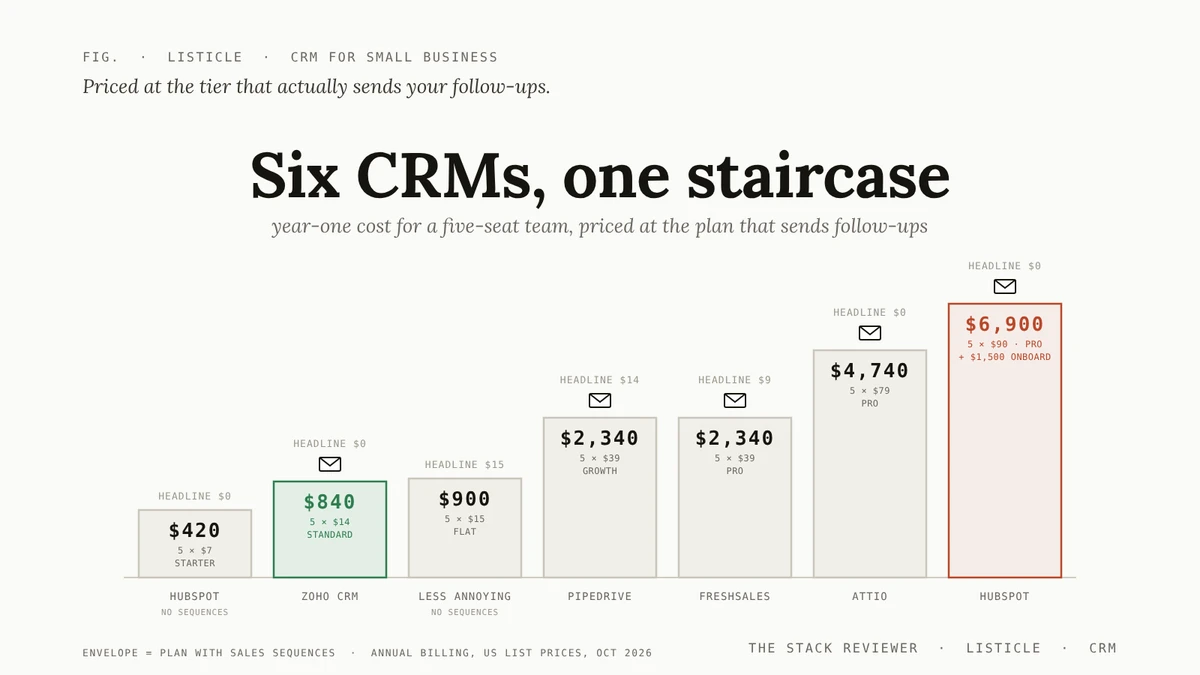
To evaluate software sustainability, buyers must look beyond headline promotional rates and scrutinize hard platform boundaries. The table below compiles pricing, capacity parameters, and support channels across the top platforms reviewed by Forbes Advisor, PCMag, and the US Chamber of Commerce.
CRM Platform |
Pricing / Top Cap |
Free Tier Capacity |
Contact Limit |
Live Support Access |
|---|---|---|---|---|
Bigin by Zoho CRM |
$21 / user / month |
Single pipeline trial |
Tier-dependent |
Standard business ticketing |
Freshsales |
Freemium / Paid upgrades |
3 users included |
Tier-dependent |
24/5 phone, chat, email |
Monday CRM |
Paid subscription |
14-day trial |
Custom per seat tier |
Web-based customer support |
Salesmate |
Paid subscription |
15-day trial |
Unlimited contacts |
Chat and ticket support |
Agile CRM |
Freemium / Paid upgrades |
10 users included |
1,000 contacts |
Standard web assistance |
HubSpot Free CRM |
Freemium / Steep upgrades |
2 users included |
1,000 contacts |
Community forum support |
Bitrix24 |
$49 / month (5 users) |
Basic cloud trial |
Tier-dependent |
Ticket and partner network |
Less Annoying CRM |
Flat single rate |
30-day trial |
Account database limits |
Direct email and phone |
A crucial economic benchmark identified in the US Chamber of Commerce guide to low-cost software is the $25 per user per month threshold. Platforms such as Bigin by Zoho CRM sit comfortably below this ceiling, allowing small businesses to scale without unexpected cost surges. Conversely, free models like HubSpot require careful scrutiny: once an organization exceeds the two-seat cap or requires custom reporting dashboards, the monthly expense can escalate rapidly into enterprise pricing tiers.
Evaluating Scalability: Salesforce Starter and Microsoft Dynamics 365
As small businesses develop complex marketing campaigns and multi-tiered customer service pipelines, simple contact-management tools can begin to feel fragmented. Salesforce frames this transition directly in its operational guidance, noting:
“Most small business CRMs do one thing really well and leave you stitching together the rest.”
To resolve this disconnect without burdening small businesses with enterprise administration overhead, the vendor developed Salesforce Starter.
Salesforce Starter combines sales tracking, marketing email sequences, and customer service ticketing within a unified interface. Engineered specifically for teams lacking dedicated IT departments or specialized software developers, the platform incorporates guided onboarding flows and native agentic AI capabilities that automate pipeline maintenance from initial setup. This approach allows a growing business to maintain institutional customer history on a platform that scales smoothly toward enterprise editions without requiring future database migrations.
Microsoft Dynamics 365 approaches scalability through deep integration with commercial productivity suites. While Dynamics 365 does not offer a free tier, it provides an affordable entry package designed to work natively alongside familiar office applications. The platform excels at coordinating automated nurturing cadences and post-purchase customer journeys. For example, when a prospective buyer downloads an educational brewing guide from a specialty coffee brand’s website, Dynamics 365 can automatically transmit targeted equipment tips two days later, assign a follow-up task to an inside sales representative, and trigger automated post-purchase maintenance reminders or accessory cross-sells once a transaction closes.
Hidden CRM Bottlenecks and How to Avoid Implementation Failure
Warning: Selecting a platform solely on initial visual appeal or low introductory pricing often conceals critical functional limitations. Tools engineered for general freelance invoicing or client onboarding—such as HoneyBook—frequently lack the sophisticated deal-stage reporting and cross-pipeline analytics necessary to identify conversion bottlenecks. When sales tracking remains fragmented across disparate spreadsheets and inbox folders, qualified prospects slip through operational cracks, creating revenue losses that far outweigh any monthly software savings.
Operational oversights routinely derail software rollouts. Writing for CO- by the US Chamber of Commerce, contributor Jessica Elliott highlights essential software features that small business operators must prioritize, including automated pipeline reminders, unified contact histories, and centralized documentation. Relying on platforms that fail to automatically capture customer touchpoints forces sales teams into manual data administration, leading to skipped follow-ups and incomplete sales metrics.
Data ownership and export barriers also represent significant operational hazards. Before deploying any platform, verify that the system permits clean, full-fidelity data exports containing complete historical activity logs, past email threads, and stage-duration notes rather than bare CSV lists of names and phone numbers. Similarly, evaluate telecom and regulatory alignment: companies utilizing integrated SMS outreach must ensure their chosen system provides native configuration tools for mandatory US carrier registration standards (such as A2P 10DLC requirements) and state-level consumer privacy controls (including CCPA opt-out handling).
Software reliability and editorial maintenance are critical when evaluating long-term business systems. Confirming the durability of the small business market landscape, PCMag published a dedicated verification notice:
“July 22, 2026: With this update, our lineup of recommended CRM software remains unchanged. We have vetted all of the existing picks for currency and availability.”
This third-party verification reinforces that established market options—led by Bigin by Zoho CRM and Freshsales—deliver consistent operational value for small business operations across the United States.
FAQ
Which small business CRM offers the most generous free plan?
Agile CRM supports up to 10 users, 1,000 contacts, and 5,000 branded emails on its free tier. However, Freshsales provides the most practical operational free plan for teams needing live help, offering 3 seats alongside 24/5 phone, chat, and email support, whereas HubSpot limits free access to 2 users.
What is the best CRM for small teams with large contact lists?
Salesmate is the standout choice for high-volume prospect tracking because it permits unlimited contacts at base tiers, avoiding the steep price jumps that platforms like HubSpot or Agile impose when contact counts exceed 1,000 records.
Can small businesses run Salesforce without hiring a dedicated IT developer?
Yes. Salesforce Starter is engineered specifically for small businesses without internal IT staff, featuring guided self-onboarding and built-in sales, customer service, and agentic capabilities within a single preconfigured environment.
Which small business CRM supports on-premises deployment rather than pure cloud?
Bitrix24 offers both cloud-hosted and self-hosted on-premises installations starting at $49 per month for five users on annual prepayment, distinguishing it from cloud-only competitors like Bigin, Salesmate, and Monday CRM.